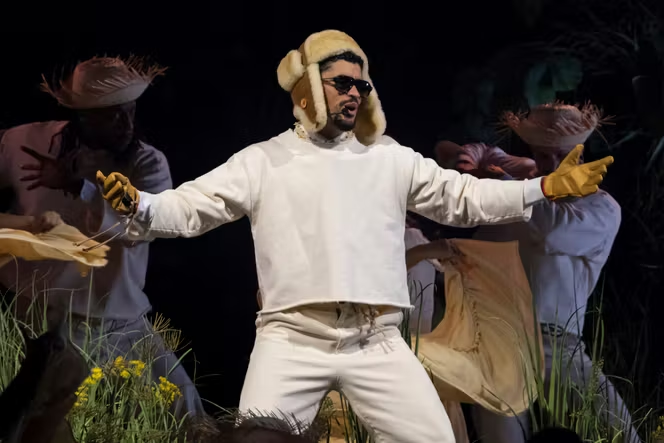
I’ll admit something — for a long time I assumed Bad Bunny was one of those artists who got put together by a label, the way some pop acts get built from scratch with a team behind them from day one. Big look, weird fashion, huge sound, must’ve had a machine behind him from the start.
Then I actually looked into how he got his start, and it’s almost the opposite story. This is a guy who was bagging groceries at a supermarket in Puerto Rico, uploading songs to SoundCloud on the side, with zero guarantee any of it would go anywhere. No machine. No plan B fallback except maybe finishing his degree.
If you’ve ever wondered how someone goes from a checkout counter to headlining the Super Bowl halftime show, here’s the actual sequence of events, not the highlight-reel version.
The Day Job That Nobody Talks About Enough
Bad Bunny — real name Benito Antonio Martínez Ocasio — grew up in Vega Baja, Puerto Rico. While he was studying audiovisual communications at the University of Puerto Rico at Arecibo, he was also working as a bagger at a local supermarket, Econo, to make ends meet.
At night, he was making music and uploading it to SoundCloud. This wasn’t a hobby he treated casually — he was clearly serious about it — but there was no reason at the time to think it was going to become his actual career. He was one of thousands of people uploading tracks to SoundCloud hoping something would catch.
I think this part matters because it’s easy to look at someone this famous now and assume the path was obvious the whole way through. It wasn’t. He was doing the unglamorous version of “grinding it out” for a long stretch before anyone outside Puerto Rico had heard his name.
The Song That Actually Changed Things
In January 2016, he uploaded a track called “Diles” to SoundCloud. It started spreading the way songs did back then — shared peer to peer, passed around within Puerto Rico’s trap and reggaeton scene, picking up steam without any radio play or label push behind it.
Eventually it caught the attention of DJ Luian, a Puerto Rican producer who signed him to his label, Hear This Music, in 2016. A remix of “Diles” featuring other established Latin trap artists like Ozuna, Farruko, Arcángel, and Ñengo Flow followed later that year, which gave him real visibility inside a scene that already had an audience.
Here’s the thing worth noticing: he didn’t get discovered by a major American label scouting talent. He got discovered by someone already embedded in the same regional scene, someone who actually heard the SoundCloud upload and recognized something in it. That’s a very different path than the “talent scout flies in and signs someone” story you usually hear.
Then “Soy Peor” Actually Broke Him Wide Open
His real breakthrough single, “Soy Peor,” dropped in December 2016. It peaked in the low twenties on the Hot Latin Songs chart, which might not sound like a huge number, but the video ended up racking up hundreds of millions of views on YouTube. That combination — chart presence plus massive organic video views — is what actually built his name outside of Puerto Rico.
This is also where his sound started getting attention for being genuinely different. He wasn’t doing a typical reggaeton delivery. He had this nasal, almost lazy-sounding vocal style layered over trap-heavy production, and it stood out specifically because it didn’t sound like everyone else in the genre at the time.
Building Momentum Through Collaborations, Not Just Solo Tracks
Through 2017, instead of just dropping more solo songs and hoping one stuck, he leaned heavily into collaborations. “Sensualidad” with J Balvin and Prince Royce. “Ahora Me Llama” with Karol G, which pulled in over 750 million YouTube views. “Krippy Kush” with Farruko, which got remixed by Nicki Minaj — meaning American artists were now actively wanting a piece of what he was doing.
Late in 2017 he also hosted Beats 1’s first-ever Spanish-language radio show, which put him directly in front of Apple Music’s platform and audience, not just YouTube and SoundCloud.
The Real Turning Point: 2018
2018 is when things stopped being “big in Latin music” and became “big, period.” He teamed up with Cardi B and J Balvin on “I Like It,” rapping in both Spanish and English, and the song hit number one on the Billboard Hot 100. He also featured on Drake’s “Mia,” which reached number three.
That one-two combination is really what pulled him into the mainstream US conversation. Up until that point, plenty of people outside Latin music circles genuinely hadn’t heard of him. After those two songs, that stopped being true.
He capped the year off releasing his debut studio album, “X 100pre,” in December 2018 — notably self-released independently through his own imprint rather than waiting on a traditional major label rollout. It went on to win a Latin Grammy for Best Urban Music Album and later landed a spot on Rolling Stone’s list of the greatest albums of all time.
What I Think Actually Made the Difference
If you’re trying to pull an actual playbook out of this story rather than just enjoying the trivia, here’s what stands out to me:
- He built a real body of independent work on SoundCloud before anyone signed him. The label deal came after there was already something worth signing.
- He got discovered inside his own genre’s ecosystem, not from outside it. DJ Luian wasn’t a stranger to the scene — he was already embedded in it.
- He didn’t rely on one breakout single. “Diles” led to “Soy Peor,” which led to a steady stream of collaborations that kept building rather than resting on one hit.
- The English-language crossover (“I Like It,” “Mia”) came after he’d already established himself in Spanish-language music, not as a substitute for it. He never dropped the language or sound that got him there in the first place.
- He kept creative control by self-releasing his debut album rather than handing the whole thing over to a major label from day one.
The Common Misconception Worth Clearing Up
The easy version of this story that gets repeated a lot is “he uploaded a song and blew up overnight.” That’s not really accurate. “Diles” catching on in January 2016 didn’t make him famous by itself — it got him signed. It took another two years of steady singles, high-profile collaborations, and a genuine crossover hit before he became the kind of name that shows up on a Super Bowl halftime lineup.
The groundwork mattered as much as the viral moment. Maybe more.
Final Thought
What sticks with me most about this story is how ordinary the starting point actually was. A college student bagging groceries, uploading music at night with no guarantee it would lead anywhere. If you’re working on something creative right now that feels small or unnoticed, that’s basically the exact position he was in before any of this happened. The visibility came later. The actual work came first, quietly, for longer than most people assume.